Monday, September 14, 2020

36. BITESIZE CATECHISM: THE DOUBLE-FEASTS OF THE HOLY CROSS WITH OUR LADY OF SORROWS & THE SIGN OF THE CROSS


APPETIZER: It is love "to the end" that confers on Christ's sacrifice its value as redemption and reparation, as atonement and satisfaction. He knew and loved us all when he offered his life. Now "the love of Christ controls us, because we are convinced that one has died for all; therefore all have died." No one, not even the holiest, was ever able to take on himself the sins of all people and offer himself as a sacrifice for all. The existence in Christ of the Divine Person of the Son, who at once surpasses and embraces all human persons, and constitutes himself as the Head of all humankind, makes possible his redemptive sacrifice for all.  The Church emphasizes the unique character of Christ's sacrifice as "the source of eternal salvation" and teaches that "his most holy Passion on the wood of the cross merited justification for us." And the Church venerates his cross as she sings in her liturgy: "Hail, O Cross, our only hope." The cross is the unique sacrifice of Christ, the "one mediator between God and humankind"..Apart from the cross there is no other ladder by which we may get to heaven." (CCC #615-618)

MAIN COURSE: To the eyes of the first Christians, the cross had no beauty. It stood outside too many city walls, decorated only with decaying corpses, as a threat to anyone who defied Rome’s authority—including Christians who refused sacrifice to Roman gods. Although believers spoke of the cross as the instrument of salvation, it seldom appeared in Christian art until after the Emperor Constantine’s edict of toleration, making Christianity a legal religion in 313 AD.

Early in the 4th century, Saint Helena, Constantine's mother, went to Jerusalem in search of the holy places of Christ’s life. She had the second-century Temple of Aphrodite torn down, which tradition held was built over the Savior’s tomb, and her son built the Basilica of the Holy Sepulcher on that spot. During the excavation, workers found three crosses. Ancient stories tell that the one on which Jesus died was identified when its touch healed a dying woman.

The Holy Cross immediately became an object of veneration. At a Good Friday celebration in Jerusalem toward the end of the 4th century, according to an eyewitness, the wood was taken out of its silver container and placed on a table together with the inscription Pilate ordered placed above Jesus’ head: Then all the people passed through one by one; bowing down, touching the cross and the inscription, first with their foreheads, then with their eyes; and then kissing the cross.  This is where we get our tradition of venerating the Holy Cross at our Good Friday services.

To this day, the Eastern Churches, Catholic and Orthodox alike, celebrate the Exaltation of the Holy Cross on the September 14th, the anniversary of the basilica’s dedication. The cross is today the universal image of Christ and of Christian belief. Countless generations of artists have turned it into a thing of beauty to be carried in procession, enshrined in churches, hung upon the walls of our homes or worn as a sign of faith.  

The gesture of the Sign of the Cross is the most popular prayer used by Christians today and is both one of the shortest and most spiritually powerful of all prayers.  While being simple enough for a toddler to learn, it carries within it two of the most important doctrines central to Christianity.  The words we recite while making the Sign of the Cross profess our belief in the truth of the Blessed Trinity: Father, Son and Holy Spirit. The gesture we make proclaims our trust in the saving death of God the Son become human, Jesus the Crucified Savior. The Church and her Saints have consistently asserted that the sign of the cross is: a confession of faith; a renewal of baptism; a mark of discipleship; an acceptance of suffering; a defense against the devil; and a wonder-working instrument of miracles.

Closely associated with the Feast of the Holy Cross on Sept. 14, is the feast of Mary under her title, Our Lady of Sorrows celebrated the next day, Sept. 15. Just as the feast of the Holy Cross reminds us of Jesus' ultimate gift of himself out of love for us, so the feast of the Sorrowful Mother recalls that Mary was intimately associated with him in the offering of this gift. Mary stood fearlessly at the cross while others fled. Mary looked on her Son’s wounds with pity, but saw in them the salvation of the world. As Jesus hung on the cross, Mary did not fear to be killed, but freely and bravely exposed herself to his persecutors. When Jesus gave the beloved disciple to Mary, we were represented by him at the foot of the cross. As Mary mothered Jesus, she became mother to all his followers in every generation.

DOGGIE-BAG: A little something to take with you for spiritual snacking...

Holy Quotes...showing that the prayer of the Sign of the Cross has been used since the earliest days of Christianity.

"At every forward step and movement, at every going in and out, when we put on our clothes and shoes, when we bathe, when we sit at table, when we light the lamps, on couch, on seat, in all the ordinary actions of daily life, we trace upon the forehead the sign of the cross." (Tertullian, ancient Church writer, 225 AD)

"All believers make the sign of the cross in whatsoever work they begin upon, and especially at the beginning of prayers, or of holy readings..." (Origen, ancient Christian writer, 285 AD)

"Let the sign of the cross be continually made on the heart, on the mouth, on the forehead, at table, at the bath, in bed, coming in and going out, in joy and sadness, sitting, standing, speaking, walking in short, in all our actions. Let us make it on our breasts and all our members, that we may be entirely covered with this invincible armor of Christians." (St. Gaudentius, 410 AD)

"Whatever may be the temptations that oppress us, we must repulse them. For this end we should make, not carelessly, but carefully, the sign of the cross, either on our forehead or on our breast." (St. Gregory of Tours, 594 AD)

The Prayer: Hail Holy Cross Our Strength

Hail, O holy Cross, our strength.
Hail, O adorable Cross, our praise and glory.
Hail, O Cross, our help and refuge.
Hail, O Cross, consolation of all the mournful.
Hail, O Cross, our victory and hope.
Hail, O Cross, our defense and our life.
Hail, O Cross, our liberation and redemption.
Hail, O Cross, our sign of salvation and bulwark against the enemy.

May the Cross be for me always hope of my faith.
May the Cross be for me resurrection in my death.
May the Cross be for me triumph against demons.

May the Cross be for me mother of my consolation.
May the Cross be for me rest in my tribulations.
May the Cross be for me support in my old age.
May the Cross be for me healing in my illness.
May the Cross be for me protection in my nudity.
May the Cross be for me consolation in my life.
May the Cross be for me solace in all my difficulties.
May the Cross be for me balm in my tribulations.
May the Cross be for me medicine to my infirmities and protection against all my enemies.
Amen.

Prayer to Mary, Mother of Sorrows
O my Mother Holy Mary,
I deliver myself to your faithful protection and your special care,now, for every day, and at the hour of my death.
I seek refuge in the bosom of your love,
and I entrust my body and soul to Jesus through your hands.

I entrust all my hopes and consolations,
all my sufferings and miseries, my life and its end
that through your most holy intercession and your merits,
all my works may be directed and performed
according to the will of your Son.

O my Lady! O my Mother! I wholly offer myself to you, and to give you a proof of my love, I now consecrate to you my eyes, my mouth, my ears, my heart, and in a word my whole being. Since therefore I am yours, O Good Mother,
preserve and defend me as your own child. Amen.

Wednesday, September 9, 2020

35. BITESIZE CATECHISM: ST. PETER CLAVER & SOCIAL JUSTICE FOR HUMAN EQUALITY


APPETIZER: Respect for the human person entails respect for the rights that flow from his dignity as a creature. These rights are prior to society and must be recognized by it. They are the basis of the moral legitimacy of every authority: by flouting them, or refusing to recognize them in its positive legislation, a society undermines its own moral legitimacy. If it does not respect them, authority can rely only on force or violence to obtain obedience from its subjects. 
Respect for the human person proceeds by way of respect for the principle that "everyone should look upon his neighbor (without any exception) as 'another self.'  No legislation could by itself do away with the fears, prejudices, and attitudes of pride and selfishness which obstruct the establishment of truly fraternal societies. Such behavior will cease only through the charity that finds in every man a "neighbor," a brother.
Created in the image of the one God and equally endowed with rational souls, all people have the same nature and the same origin. Redeemed by the sacrifice of Christ, all are called to participate in the same divine blessedness of Heaven: all therefore enjoy an equal dignity. Human equality rests essentially on their dignity as persons and the rights that flow from it.  Every form of social or cultural discrimination in fundamental personal rights on the grounds of sex, race, color, social conditions, language, or religion must be curbed and eradicated as incompatible with God's design. 
There exist also sinful inequalities that affect millions of men and women. These are in open contradiction of the Gospel: Their equal dignity as persons demands that we strive for fairer and more humane conditions. Excessive economic and social disparity between individuals and peoples of the one human race is a source of scandal and militates against social justice, equity, human dignity, as well as social and international peace. (CCC #1930-1938)
MAIN COURSE: The social teaching of the Catholic Church quoted above in our Appetizer is so  vitally important in that I ask you to read it again. Slowly. Ponder it. It truly contains the solution to the racial and economic disparities we are seeing in the USA today.  And the Saint of the Week we are learning about - St. Peter Claver - is an outstanding example of someone who took this teaching to heart and made it the focus of his priestly ministry in  very unjust and oppressive culture.
Pedro (Peter) Claver was born to a prosperous family in Verdu, Spain, and earned his first degree in Barcelona. He entered the Jesuits in 1601. When he was in Majorca studying philosophy, Claver was encouraged by Alphonsus Rodriguez, the saintly doorkeeper of the college, to go to the missions in America. Claver listened, and in 1610 he landed in Cartagena, Colombia. After completing his studies in Bogotá, Peter was ordained a priest in Cartagena in 1616.


Cartagena was one of two ports where slaves from Africa arrived to be sold in South America. Between the years 1616 and 1650, Peter Claver worked daily to minister to the needs of the 10,000 slaves who arrived each year.  He would head for the wharf as soon as a slave ship entered the port. Boarding the ship, he entered the filthy and diseased holds to treat and minister to their badly treated, terrified human cargo, who had survived a voyage of several months under horrible conditions. It was difficult to move around on the ships, because the slave traffickers filled them to capacity. After the slaves were herded from the ship and penned in nearby yards to be scrutinized by crowds of buyers, Claver joined them with medicine, food, bread, brandy, lemons and tobacco.


St. Peter gave short instruction in the Catholic faith and baptized as many as he could. In this way he could prevail on the slave owners to give humane treatment to fellow Christians. He would then follow up on them to ensure that as Christians they received their Christian and civil rights. His mission extended beyond caring for slaves, however. He preached in the city square, to sailors and traders and conducted country missions, returning every spring to visit those he had baptized, ensuring that they were treated humanely. During these missions, whenever possible he avoided the hospitality of planters and overseers; instead, he would lodge in the slave quarters.


St. Peter Claver baptized more than 300,000 slaves by 1651, when he was sickened by the plague.  He stands out for us today as a heroic servant of the sick who ministered to their material and spiritual needs without closeting himself to remain free from infection. Claver's work on behalf of slaves and the sick did not prevent him from ministering to the well-to-do members of society, traders and visitors to Cartagena (including Muslims and English Protestants) and condemned criminals. Through years of unremitting toil and the force of his own unique personality, the slaves' situation slowly improved. In time he became a moral force, being called the "Apostle of Cartagena".

In the last years of his life Peter was too ill to leave his room. The ex-slave who was hired to care for him treated him cruelly, not feeding him many days, and never bathing him. Claver never complained. He was convinced that he deserved this treatment. In 1654 Peter was anointed with the oil of the Sacrament of the Sick. When Cartagenians heard the news, they crowded into his room to see him for the last time. They treated Peter Claver’s room as a shrine, and stripped it of everything but his bedclothes to be treasured as relics and mementos. Claver died September 7, 1654, at the age of 53.

During his trip to Colombia, Pope Francis visited the Shrine of St. Peter Claver in Cartagena. Pope Francis said of him, “Saint Peter Claver was austere and charitable to the point of heroism. After consoling hundreds of thousands of people in their loneliness, he died without honors and was not remembered, having spent the last four years of his life in sickness and confined to his cell which was in a terrible state of neglect. This how the world paid him, yet God paid him in another way.” 

Unlike many of his own countrymen, Claver saw these people as human beings and not animals.
He devote his whole life and ministry to advocating that they receive the same respect and dignity that was given to anyone else. He cared deeply about them and the salvation of their souls, believing that each one needed to hear the Gospel of Jesus Christ.  However, he didn’t simply talk about equality.  Above all, St. Peter Claver shows us clearly how actions speak louder than words and if we want true racial equality in the world, it must first begin with ourselves and how we treat other people we encounter on a daily basis.

Like Peter Claver, as Catholic Christians we are called to act with mercy and treat each other as brothers or sisters in the spirit and practice of human fraternity. We are called to uphold the dignity and equality of all people, no matter who they might be for all, as both Sacred Scripture and the Catechism teach us, are created in the image and likeness of God. 

DOGGIE-BAG: A little something to take with you for spiritual snacking...

Holy Quotes...

"We must speak to the needy and suffering with our hands by giving, before we try to speak to them with our lips about God and faith." (St. Peter Claver)

“How I desire that we Christians be more deeply united as witnesses of mercy for the human family so severely tested in these days. Let’s ask the Spirit for the gift of unity, for only if we live as brothers & sisters can we spread the spirit of fraternity.” (Pope Francis, May, 2020)

Prayer in Honor of St. Peter Claver (from the Liturgy for Sept. 9)

O God, who made Saint Peter Claver a slave of slaves 
and strengthened him with charity and patience as he came to their help, 
grant, through his intercession, that, seeking the things of Jesus Christ, 
we may love our neighbor in deeds and in truth. Amen.


INVOCATIONS IN HONOR OF SAINT PETER CLAVER.

Peter Claver, worthy son of St. Ignatius,  pray for us. 
Peter Claver, priest of God and servant to the Church,  pray for us. 
Peter Claver, generous imitator of St. Francis Xavier,  pray for us.
Peter Claver, brilliant light of the New Word,  pray for us. 
Peter Claver, who exchanged the riches of this world for evangelical poverty,  pray for us.
Peter Claver, apostle to blacks brought to the New World,  pray for us. 
Peter Claver, who by vow made thyself slave of the slaves,  pray for us.
Peter Claver, refuge of the miserable,  pray for us. 
Peter Claver, great wonder worker,  pray for us. 
Peter Claver, who cured the sick and consoled the afflicted,  pray for us. 
Peter Claver, Liberator of slaves unto the freedom of the children of God,  pray for us.  
Peter Claver, model of evangelical industry,  pray for us. 
Peter Claver, tender father of the poor and orphans,  pray for us. 
Peter Claver, who made thyself all things to all in order to gain them for Christ,  pray for us. 
Peter Claver, who in all trials of this life didst put thy trust in God,  pray for us. 
Peter Claver, who wished to be accounted as nothing and forgotten by men,  pray for us.  
Peter Claver, who sought no other wisdom but the folly of the Cross,  pray for us. 
Peter Claver, shining example of humility and self renunciation,  pray for us. 
Peter Claver, perfect example of obedience and subjection,  pray for us. 
Peter Claver, intrepid apostle, powerful in word and deed,  pray for us. 
Peter Claver, martyr for Christ for the salvation of souls,  pray for us. 
Peter Claver, zealous lover of the most Holy Sacrament of the Eucharist,  pray for us.  
Peter Claver, imitator of the suffering Savior,  pray for us. 
Peter Claver, powerful protector of all who invoke thee,  pray for us.   

Scripture Quote to Memorize:  "There is no longer Jew or Gentile, slave or free, male and female. For you are all one in Christ Jesus." (Galatians 3:28)

Tuesday, September 1, 2020

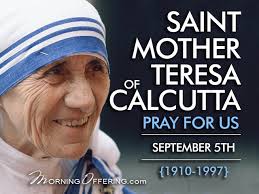
34. BITESIZE CATECHISM: ST. MOTHER TERESA OF CALCUTTA & LIVING AS MISSIONARIES OF CHARITY


APPETIZER: Charity is the God-given virtue by which we love God above all things for his own sake, and our neighbor as ourselves for the love of God. Jesus makes charity the new commandment. By loving his own "to the end," he makes manifests the Father's love which he receives. By loving one another, the disciples imitate the love of Jesus which they themselves receive. This is why Jesus says: "As the Father has loved me, so have I loved you; abide in my love." And again: "This is my commandment, that you love one another as I have loved you. The fruits of charity are joy, peace, and mercy; charity demands that we practice active kindness and also lead others to doing good; it is good will that fosters mutual kindness and remains unselfish and generous; it promotes friendship and unity.  Love is itself the fulfillment of all the commandments of God. (cf. CCC 1822, 1823, 1829)

MAIN COURSE: Born to Albanian parents in what is now Skopje, Macedonia, Agnes Bojaxhiu was the youngest of the three children. For a time, the family lived comfortably, and her father’s construction business thrived. But life changed overnight following his unexpected death. During her years in public school, Agnes participated in a Catholic youth group and showed a strong interest in the foreign missions. 

At age 18, she entered the Loreto Sisters of Dublin and was was assigned to teach in a high school for wealthy girls in Calcutta. But she could not escape the realities around her—the poverty, the suffering, the overwhelming numbers of destitute people that she saw everyday just outside her comfortable convent-school.  In 1946, while riding a train to her annual retreat, Sister Teresa heard what she later explained as “a call within a call. The message was clear.  she said that Jesus told her, "I was to leave the convent and help the poor while living among them; to follow Christ into the slums to serve him among the poorest of the poor.” She received permission to establish a new religious community and undertake her new work. She went to Calcutta, where she lived in the slums and opened a school for poor children. Soon several of her former students at the wealthy school for girls joined her and with Mother Teresa as their leader, the group became the pioneer Missionaries of Charity Sisters (called MC Sisters for short). 

These new Sisters dressed in blue-bordered white saris and wore simple sandals–the ordinary dress of an Indian woman– something quite unusual back in the 1950's. To us in the USA the MC Sisters look like traditional nuns in long dresses with veil-covered heads, but in India they blend right into a crowd.  To distinguish themselves in dress from other women, they pinned a small crucifix on their shoulders to hold the sari in place, and strung a rosary from their belts.  They soon began getting to know their neighbors—especially the poor and sick—and getting to know their needs through visits. The work was exhausting, but others helped by donating food, clothing, supplies, and the use of buildings. 

As the order expanded, services were also offered to orphans, abandoned children, alcoholics, the aging, and street people.  Before the end of the 20th century there were Missionaries of Charity in every part of the world and this religious family grew to include Missionaries of Charity Brothers,  Priests, contemplative nuns and lay associates, becoming one of the largest religious communities in the Church.  For the next four decades, Mother Teresa worked tirelessly on behalf of the poor. Her love knew no bounds. Nor did her energy, as she crisscrossed the globe pleading for support and inviting others to see the face of Jesus in the poorest of the poor. In 1979, she was awarded the Nobel Peace Prize. On September 5, 1997, God called her home. Mother Teresa of Calcutta was canonized a saint by Pope Francis on September 4, 2016.

There are many lessons of the Catechism that are exemplified in the life of St. Mother Teresa. But the one that stands out for me overall, and is one which is so much needed by us today: the teaching of Christ and of Scripture that Charity is the greatest of all virtues and a non-negotiable commandment given to us by Jesus. This is why St. Teresa named her new community the Missionaries (which means Ambassadors) of Charity (which is the highest form of love).   It is a title that really belong to each and every Christian: we are all called by our baptism and confirmation to be missionaries of charity where we live, work and socialize. Pope Francis calls this being a missionary disciple.

Charity is hard to accurately translate into modern English.  We tend to think of charity as doing something kind to another person, particularly the poor. And that's part of it but not the full definition. It means a higher universal kind of love that is like God's love as described in St. Paul's First Letter to the Corinthians: "Love is patient and kind; it is not jealous or conceited or proud; love is not ill-mannered or selfish or irritable; love does not keep a record of wrongs; love is not happy with evil, but is happy with the truth. Love never gives up; and its faith, hope, and patience never fail.Love is eternal." (1 Cor 13:4-8). 

Mother Teresa called the task of spreading charity "doing something beautiful for God".  And this is what we need to learn from her today as we strive to live our Christianity in the midst of a society that is becoming so self-focused, mean-spirited, divisive and violent.  We need to take up our Christian mission seriously and become missionary disciples of charity right where we are planted. How do we do this?  What does it look like to do something beautiful for God?  Let's listen to Mother St. Teresa!

Do you want to do something beautiful for God? Find a person who needs you. Be the living expression of God’s kindness; kindness in your face, kindness in your eyes, kindness in your smile.

Peace begins with a smile. Every time you smile at someone, it is an action of love, a gift to that person, a beautiful thing. We will never understand all the good that a simple smile can accomplish. 
Smile at each other. Smile at your wife, smile at your husband, smile at your children, smile at each other – it doesn’t matter who it is – and that will help to grow up in greater love for each other.

I never look at the masses as my responsibility. I look at the individual. I can love only one person at a time. I can feed only one person at a time. Just one, one, one. It is not how much we do, but how much love we put in the doing. It is not how much we give, but how much love we put in the giving.

If we really want to love we must learn how to forgive. If each of us would only sweep our own doorstep, the whole world would be clean.

Your true character is most accurately measured by how you treat those who can do ‘nothing’ for you. If you judge people, you have no time to love them.

We think sometimes that poverty is only being hungry, naked and homeless. The poverty of being unwanted, unloved and uncared for is the greatest poverty. We must start in our own homes to remedy this kind of poverty.

I used to believe that prayer changes things, but now I know that prayer changes us, and we change things.  The beginning of prayer is silence. If we really want to pray we must first learn to listen, for in the silence of the heart God speaks. And to be able to see that silence, to be able to hear God we need a clean heart; for a clean heart can see God, can hear God, can listen to God; and then only from the fullness of our heart can we speak to God. But we cannot speak unless we have listened, unless we have made that connection with God in the silence of our heart.

We need to find God, and he cannot be found in noise and restlessness. God is the friend of silence. See how nature – trees, flowers, grass- grows in silence; see the stars, the moon and the sun, how they move in silence… We need silence to be able to touch souls.

DOGGIE-BAG: A little something to take with you for spiritual snacking...

The best doggie-bag take-aways for this week are found in the quotes from Mother Teresa above. But I do want to include this prayer by Mother St. Teresa that is recited by the Missionaries of Charity Family every day...

Dear Jesus, help me to spread Thy fragrance everywhere I go. Flood my soul with Thy spirit and love. Penetrate and possess my whole being so utterly that all my life may only be a radiance of Thine. Shine through me and be so in me that every soul I come in contact with may feel Thy presence in my soul. Let them look up and see no longer me but only Jesus. Stay with me and then I shall begin to shine as you shine, so to shine as to be a light to others. Amen.

Scripture Verse to Memorize: "Truly I tell you, whatsoever you do for the least of my brothers and sisters, that you do to me." (Jesus, in Matthew 25:40)


Tuesday, August 25, 2020

33. BITESIZE CATECHISM: OUR LADY OF CZESTOCHOWA & THE USE OF SACRAMENTALS


APPETIZER: Holy Mother Church has instituted sacramentals which are sacred signs that bear a resemblance to the sacraments. They signify effects, particularly of a spiritual nature, which are obtained through the intercession of the Church. By them people are disposed to receive the chief effect of the sacraments, and various occasions in life are rendered holy. Sacramentals do not confer the grace of the Holy Spirit in the way that the sacraments do, but by the Church's prayer, they prepare us to receive grace and dispose us to cooperate with it. For well-disposed members of the faithful, the liturgy of the sacraments and sacramentals sanctifies almost every event of their lives with the divine grace which flows from the Paschal mystery of the Passion, Death, and Resurrection of Christ. From this source all sacraments and sacramentals draw their power. There is scarcely any proper use of material things which cannot be thus directed toward the sanctification of human beings and the praise of God. The religious sense of the Christian people has always found expression in various forms of piety surrounding the Church's sacramental life, such as the veneration of relics, visits to sanctuaries, pilgrimages, processions, the stations of the cross, the rosary, medals, icons, etc. (CCC #1667, #1670, #1674)

MAIN COURSE:  Our Saint of the Week is the Blessed Mother under her title of Our Lady of Czestochowa, Queen of Poland, whose feast day is August 26. I have chosen this topic and this feast because it stands out strongly for two things that are very "Catholic": the use of sacramentals and a relationship with Mary as Mother and Protectress.  

First let's take a look at the story of this holy icon and then we will study what we Catholic believe about sacramentals. Even for those who are not Polish-Americans, the icon of Our Lady of Czestochowa is a powerful reminder of our spiritual mother's protection and care.  Pope St. John Paul II was a HUGE proponent of this icon and devotion in modern Catholicism. It held a deeply special place in his heart and spirituality.

This sacred icon is a very famous painting of the Blessed Virgin holding the Child Jesus and is among the most ancient images of the Blessed Mother and Child Jesus in Christianity. Under this title, Mary is the Patron and Protector of Poland. Since the face of Mary is very dark, she is often referred to as the Black Madonna of Poland. This darkening of the image comes from centuries of soot and smoke from candles illuminating the icon. The picture follows the traditional form of an icon. Mary gestures toward Jesus, directing the attention away from her and pointing to Jesus as the source of salvation.  This is and continues to be Mary's mission: to present Jesus to the world. The Child Jesus extends his right hand in blessing to the viewer of the painting.  He holds a Book of the Gospels in his left hand reminding us that He is the Incarnate Word of the Father who came to speak the Word of God to us.

The painting of the Madonna has a long history.  Saint Helen the Empress found this painting when she went to Jerusalem in the 4th century in search of the true Cross of Christ. She gave the painting to her son, the Emperor Constantine. When the city of Constantinople was invaded by enemies the people prayed to Mary before this icon and the city was saved. This began the great devotion to the Blessed Virgin Mary attached to this painting.  In 1382, Prince Ladislaus of Poland sought to protect the holy image from invading barbarians. On his journey to his hometown where he planned to hide the icon, he stopped and spent the night at village called Czestochowa. The next day, as he began to continue the journey, the horses pulling the wagon with the painting of Our Lady refused to move. After repeatedly unsuccessful attempts to force the animals forward, Prince Ladislaus took this as a sign that the painting was to remain in Czestochowa. The icon was placed in the care of the Order of the Hermits of Saint Paul at their monastery called the Mount of Light, or in Polish, Jasna Gora. The icon of the Black Madonna, Our Lady of Czestochowa, has remained there to this day.

The sacred icon was again in danger and damaged in 1430 when a band of marauding invaders looted the monastery. Twice the painting was struck with a sword repeatedly in order to extract the gold and jewels that adorned it.  Despite trying to repair the painting afterwards, the sword cuts and the arrow wound are still visible in the painting today.  Look at you will see the scars on Mary's face and neck, giving this icon one of its most distinctive characteristics. But these "wounds" also brought a sense of solidarity with Our Lady among the people because they saw in these markings a symbolism of the desire of Mary to suffer with them and protect them. 

Through this connection the hearts of the Polish people grew stronger in their attachment to and love for the Beloved Mother.  They refurbished the icon with jewels as a signs of their love and adorned both Jesus and Mary with crowns, officially declaring the the Blessed Virgin to be the one only Queen of Poland. God seems to have blessed this devotion as is evidenced by the many conversions,  healings and miracles that have been attributed to prayers to Our Lady of Czestochowa over the years.

The icon and devotion was hugely inspirational in the Poland's successful fight for freedom from the USSR in the late 20th century. The shrine of Czestochowa was a gathering place for the Solidarity movement and the icon became both a spiritual and a political symbol igniting and uniting the people in their struggle for civil and religious rights.  What is so beautiful about the Icon of Czestochowa is that it shows all of us Catholic people, no matter what our ethnicity, the purpose and power of the sacramentals of the Church to enable us to live as Christians committed to peace and justice. And that leads us perfectly into this week's Bitesize study.

As we read in the Appetizer, sacramentals are tangible actions and items that the Church approves and blesses to aid us in our spirituality and in living the Gospel as Christians in the world.  They have a name that is very similar to Sacraments, but they do not possess the supernatural grace and power of the sacraments. Instead, they nurture us spiritually to more faithfully and effectively receive the sacraments. The sacramentals DO bring us the grace and power of God but they do so because of the prayers and blessings of the Church, the Mystical Body of Christ, and not becaus eo anything they possess in and of themselves.

A very important thing to remember when using sacramentals is that they are not protection-charms or magic amulets. This may sound funny to you, but many Catholics I have encountered tend to have this rather superstitious attitude. For example, I was once asked by a non-practicing Catholic who had not been to Mass or Confession for years, if I had a brown scapular he could wear for an upcoming airplane flight. I asked why he wanted it (though I knew the answer). "Because people who die wearing the brown scapular go to heaven!" Obviously, he had heard that said when he was a kid but sadly no one had put it into proper context for him. He had no clue that the scapular was simply a blessed sign of our relationship with Christ through Mary and that it has no supernatural power of its own accord! But I was glad to see that he at least still had some level of connection with God and heaven!

I love sacramentals and make good use of them myself.  Icons, statues, rosaries, medals all have a prominent but proper place in my home, in my life,  and in my spirituality. And as a deacon one of the things I love best is blessing people and the religious items they bring for a blessing.  I just hope and pray that all who use them will grow in their relationship with God, draw closer to Christ, live the Gospel more wholeheartedly, receive the Sacraments more frequently, and serve others more generously.  This is, after all, the ver reason and purpose why they have been given to us by the Church.

DOGGIE-BAG: Something to take with you for spiritual snacking...

From our Catholic Tradition:  Here is a short explanation of some of our more popular sacramentals.  It is nearly impossible to list all of them, but suffice it to say that a sacramental is ANY item or action of devotion that receives the official blessing of the Church through her ministers (bishops, priests or deacons).  

Rosary/Prayer Beads. The rosary has roots in several early Christian prayer traditions. They share similar formats to the rosary with repetitive structures and prayers.  3rd century Christian hermits and monks in Egypt used stones and later prayer ropes to keep track when praying the 150 Psalm or when reciting  the "Jesus Prayer” (“Lord Jesus Christ, Son of God, have mercy on me.”)  The Our Father was also prayed 150 times, using a string of beads with five decades referred to as a Paternoster (Latin for “Our Father”).   The full rosary has 20 decades (a decade is groups of 10 beads or knots) but much more common is a rosary of 5 decades or even those which have just 1 decade.  The heart of the rosary though is not in the reciting of memorized repeated prayers but in reflection on the Mysteries (events) from the life of Jesus and to a lesser extent of Mary.  In addition to the Marian Rosary which most Catholics know about, there are many other devotions that make use of prayer-beads (such as the Chaplet of Divine Mercy).

Miraculous Medal. The Blessed Virgin herself designed the Medal of the Immaculate Conception—popularly known as the Miraculous Medal - because of the many conversions and healings associated with its proper devout use. It was given to the Church by Our Lady in her Church investigated and approved apparitions to St. Catherine Laboure in Paris in 1830.  Mary said that extraordinary graces wpould be poured out upon those who wear it and pray for Mary's intercession with trust.

Brown Scapular/Scapular Medal. This scapular consists of two pieces of brown cloth of any material that is worn over the shoulders with one piece on the chest and the other on the back (thus its name of scapular, coming from the shoulder blades which are anatomically called "scapulas").  It is a miniature version of the full length scapular garment worn by friars and nuns of the Carmelite Order. According to the Church, wearing the scapular the Brown Scapular is an external sign of the childlike relationship established between the Blessed Virgin Mary of Mount Carmel, and those who entrusts themselves totally to her protection, who have recourse to her maternal intercession, and who devote themselves to a life of regular prayer.  If a person so wishes a Scapular Medal may be worn in place of the cloth scapular.  Such a medal has an image of Jesus with his Sacred Heart on one side and an image of Our Lady on the other side and is specially blessed to replace the cloth scapular.

Holy Water.  Water that has been specially blessed by a bishop. priest or deacon for use by making a sign of the cross when entering a church reflects a renewal of baptism, a cleansing of venial sin, and for protection against evil. Its primary connection is with Baptism and  thus the sprinkling of holy water is common in rituals for many of the sacraments and prayer services.  It is a good custom for families to have a holy water font (container) in their home so that the members can make use of it for prayer and asking God;s blessing when leaving the home.

St. Benedict Cross-Medal. For the early Christians, the cross was a favorite symbol of their faith in Christ. From the writings of St. Gregory the Great (540-604), we know that St. Benedict had a deep faith in the Cross and worked miracles with the Sign of the Cross. This faith in, and special devotion to, the Cross was passed on to succeeding generations of Benedictines.  This gave rise to the making of medals that bore the image of St. Benedict holding a cross aloft in his right hand and his Rule of Life in the other hand. Thus, the Cross has always been closely associated with the Medal of St. Benedict, which is often referred to as the Medal-Cross of St. Benedict. It is one of the few sacramentals that has a very special blessing that can be given by any bishop, priest or deacon.  It has come to be properly used as a means for combatting evil, overcoming temptations and healing the sick through the Cross of Christ and the intercession of St. Benedict.

Scripture Verse to Memorize: "People would take handkerchiefs and aprons that had touched Paul’s skin to those who were sick. Their sicknesses would be cured, and evil spirits would leave them." (Acts 19:12. This verse shows us that the sacramentals we call relics - which are items touched to the body of a saint - were used even in New Testament times.)


Wednesday, August 19, 2020

32. BITESIZE CATECHISM: ST. POPE PIUS X & CHRISTIAN POLITICAL ACTION


APPETIZER:  In keeping with the social nature of human beings, the good of each individual is necessarily related to the common good. By common good is to be understood as social conditions which allow people, either as groups or as individuals, to reach their fulfillment more fully and more easily. The common good concerns the life of all. persons (unborn and born).  It consists of three essential elements First, the common good presupposes respect for the human person. Public authorities are bound to respect the fundamental and inalienable rights of the human person, their exercise of the natural freedoms indispensable for the development of the human vocation, to safeguard privacy, and give rightful freedom also in matters of religion.  Second, the common good requires the social well-being and development of the group itself. Certainly, it is the proper function of authority to arbitrate, in the name of the common good, between various particular interests; but it should make accessible to each what is needed to lead a truly human life: food, clothing, health,work, education and culture, suitable information, the right to establish a family, and so on. Finally, the common good requires peace, that is, the stability and security of a just order. It presupposes that authority should ensure by morally acceptable means the security of society and its members. It is the basis of the right to legitimate personal and collective defense. The common good is founded on truth, built up in justice, and animated by love. (See CCC #1905-1912)

MAIN COURSE:  Joseph Sarto was born in Riese, Italy on June 2, 1835, the second of 10 children in a poor working-class family. Though poor, his parents valued education. Joseph walked 4 miles to school each day as well as studied Latin with the village priest in preparation for seminary studies. He was ordained a priest in 1858; then a bishop in 1879 and then the Cardinal Archbishop of Venice in 1893. On August 4, 1903, he was elected pope after much political controversy and several voting sessions.

Ever mindful of his humble origin, the new Pope, who took the name of Pius X stated, “I was born poor, I lived poor, I will die poor.” He was embarrassed by some of the pomp and extravagance of the papal court. “Look how they have dressed me up,” he said in tears to an old friend. To another, “It is a penance to be forced to accept all these practices. They lead me around surrounded by guards like Jesus when he was seized in the Garden of Gethsemane.”

In many ways, Pius X was a forerunner of a poorer and simpler papacy 100 years before Pope Francis began this reform. His humble origins became clear right after his election, when he wore a pectoral cross made of gold-finished metal instead of real gold. He was well known for cutting down on papal ceremonies. He also abolished the custom of the pope dining alone and invited his friends to eat with him. His mother was a good influence in this regard of keeping her son, Joseph, humbly mindful of his roots. It is said that when he became pope and extended his hand to her for her to kiss his papal ring (as was the custom at the time) she responded by extending her hand with her wedding ring on it saying, “If I did not have this ring, you would not have yours!” No word on if she ever did kiss her son’s ring!

On the 11th anniversary of his election as pope, Europe was plunged into World War I. Pius had foreseen it and it killed him. “This is the last affliction the Lord will visit on me. I would gladly give my life to save my poor spiritual children from this ghastly scourge.” He died a few weeks later, on August 20, 1914.  his liturgical feast day is celebrated on August 21.

He did so much for the life of the average everyday Catholic that he has become known as a "pope of the people". He promoted daily Holy Communion and lowered the age of First Communion to 6 or 7 years; he encouraged singing at Mass and asked parishioners to become more informed about the Liturgy; he supported the CCD religious ed programs and asked every parish in the world to have classes. 

But what I really want to focus on in our Bitesize Catechism this week is his insistence that Catholics become active participants in the political-social life of their nations and communities. 

Pope St. Pius X encouraged Catholics to become more politically savvy and involved.  He taught that we can best renew society and restore all things in Christ, by firmly grounding our political policies and exercising our voting rights in the light of the Gospel.  An important test that a Catholic can give themselves regarding his or her priorities between religion and politics is this: If a political platform conflicts with the teaching of Christ, do I stick with Christ or do I stick with my political party/policies?  If I choose politics over Jesus then I need to re-examine my faith-commitment and honestly ask myself if I am a disciple of Christ or not. 

DOGGIE-BAG: A little something to take away with you for spiritual snacking...


Prayer in Election Year
Lord God, as the election approaches,
we seek to better understand the issues and concerns that confront our nation and how the Gospel compels us to respond as faithful citizens in our community.
We ask for eyes that are free from blindness
so that we might see each other as brothers and sisters,
one and equal in dignity,
especially those who are victims of abuse and violence, deceit and poverty.
We ask for ears that will hear the cries of children unborn and those abandoned,
Men and women oppressed because of race or creed, religion or gender.
We ask for minds and hearts that are open to hearing the voice of leaders who will bring us closer to your Kingdom. We pray for discernment
so that we may choose leaders who hear your Word,
live your love,
and keep in the ways of your truth
as they follow in the steps of Jesus and his Apostles
and guide us to your Kingdom of justice and peace. We ask this in the name of your Son Jesus Christ and through the power of the Holy Spirit. Amen.
IMPORTANT THINGS TO KNOW REGARDING FAITH & POLITICS...
4 Basic Principles for Catholic Political Action:
1. Have a well-formed Conscience, which we attain by reading, knowing the teachings of Christ and making decisions in the light of prayer.
2. Exercise the virtue of Prudence, which means choosing the best workable option among several choices.
3. Make Choices that Do Good and Avoid Evil - we keep in mind that the end result never justifies the means of getting there.
4. Make Positive Moral Choices - our decisions must reflect the truth that god reveals to us in Christ.  Religion is not just something for Sundays. For it to be a Faith that saves us it must have guide our social and political choices as well as our personal spiritual ones.
4 Foundations of Catholic Social Teaching:
1. The Dignity  and Life of the Human Person, from womb to tomb. Our political choices must promote and defend life from conception through natural death.
2. Subsidiarity which means that our politics and government should carry out most of its responsibilities at the most local level possible. In other words, it does not support "Big Government".
3. The Common Good - see the explanation for this in the Appetizer above.
4. Solidarity which means we stick together and help one another as brothers and sisters in the human family, with no room for discrimination or exclusion based on race, creed, economics, etc.
The U.S. Bishops also have produced a list of non-negotiable issues for Catholics:
  • Standing up for Human life in all its stages and defending it against all attacks
  • Promoting Peace, Law, Order and Justice
  • Upholding the Dignity and Rights of Traditional Marriage and Family Life
  • Safe-guarding Religious Freedom and Freedom of Conscience 
  • Having a Preferential Option for the Poor and Seeking Economic Justice
  • Understanding that Health Care and Education as basic human rights
  • Balancing the two sides of Migration - the right for people to migrate and the right for host-nations to regulate this migration with mercy and in justice
  • Caring for the Environment in a manner that respects human life and the common good
  • Demanding Truth in Communications and Media

You can read more to inform yourself about faith and politics in this Election Year by going to the website of the United States Conference of Catholic Bishops where you will find a plethora of materials and articles: https://www.usccb.org/issues-and-action/faithful-citizenship/church-teaching


49. BITESIZE CATECHISM: THE SEASON OF LENT - ASH WEDNESDAY

  APPETIZER:  Jesus’ temptation in the wilderness reveals the way in which the Son of God is Messiah, contrary to the way Satan proposes to ...