Wednesday, April 22, 2020

16. THE LIFE OF JESUS: FIFTH LUMINOUS MYSTERY - THE INSTITUTION OF THE EUCHARIST


APPETIZER: "At the Last Supper, on the night he was betrayed, our Savior instituted the Eucharistic sacrifice of his Body and Blood. This he did in order to perpetuate the sacrifice of the cross throughout the ages until he should come again, and so to entrust to his beloved Spouse, the Church, a memorial of his death and resurrection: a sacrament of love, a sign of unity, a bond of charity, a Paschal banquet 'in which Christ is consumed, the mind is filled with grace, and a pledge of future glory is given to us.'"  The inexhaustible richness of this sacrament is expressed in the different names we give it. Each name evokes certain aspects of it."(CCC #1333, 1338)  The Sacred or Divine Liturgy means the participation of the People of God in the work of God...Through the liturgy Christ, our redeemer and high priest, continues the work of our redemption in, with, and through his Church. In it full public worship is performed by the Mystical Body of Jesus Christ, that is, by the Head and his members. From this it follows that every liturgical celebration, because it is an action of Christ the priest and of his Body which is the Church, is a sacred action surpassing all others." (CCC #1669-1670) 

MAIN COURSE:  Let's delve into our main course by taking a quick look at some of these names that are given to the Eucharist. First of all it is called Eucharist because it is an action of thanksgiving to God and comes from the Greek word for "giving thanks, eucharistein. It is The Lord’s Supper, because of its origin at the last supper of Jesus with his disciples on the eve of his Passion.  The New Testament name that the first Christians used for celebrating the Eucharist was The Breaking of Bread, because Jesus blessed, broke and distributed the bread at the Last Supper. 

The titles of Eucharistic Assembly and Liturgy are both very ancient and very interesting. "Assembly" conveys the truth that the Eucharist is a corporate worship offered to God by all the baptized faithful as a visible expression of the Church,as the Mystical Body of Christ. "Liturgy" (as we read in the Appetizer above) means that while the priest leads the worship - as the ordained presider with the spiritual authority to consecrate the Eucharist - each and every one of the faithful present worship and offer  Christ with him. This is why both the Church's canon law and liturgical directives state that a priest  may only celebrate Mass by himself for a very serious reason.  This is also how non-ordained members of the Church express and exercise their priestly baptismal mission.


Calling the Eucharist the Holy Sacrifice, reminds us that it makes present to us, in a supernatural way, the one sacrifice of Christ the Savior on the cross.  This is why the Church directs that a crucifix must always be on or near the altar.  However, we do not receive a dead Savior but the Living Lord, whose Resurrection is also made present to us at the Mass.

This does not mean, as many fundamentalist Protestants assert, that we believe the crucifixion was deficient or that we somehow symbolically "crucify" Jesus again at Mass!  The best way I've heard it explained is that the Mass is kind of like a supernatural time machine by which we are brought into a real but mystical contact with the Cross and Resurrection of Christ. Through the Mass his Paschal Mystery is made present to Christians of every time and place. Awesome!

We call this sacrament Holy Communion, (which means "with unity") because though it we are united with Christ, who makes us sharers in his Body and Blood. Furthermore, we are also united in Christ with all who receive the Eucharist and all together we form a single body, the Mystical Body of Christ.  The term Blessed Sacrament is also used because it reminds us that this sacrament is the crown of all the sacraments since it is truly Christ himself.

Finally we most commonly refer to the Eucharist as the Mass, from the Latin Missa, which means "sent out on a mission". When the liturgy concludes we are told to go out on a mission ("ite missa est") by the deacon.  He sends us forth to be witnesses to the Risen Lord among those with whom we live, work and socialize. We are to "be the Eucharist that we have received" (St. Augustine) by giving of ourselves out in service to others.

As you can tell even just from the various names give to it, there is so much that can and should be said about the Holy Eucharist.  However, we cannot hope to cover it all in our Bite-size Catechism. Countless books - from the devotional and popular to the extremely academic and scholarly - have been written and are easily available. See a few suggestions I give below if you want to pursue further reading and study on this Blessed Sacrament. 


What I will focus in this week's serving of the Catechism is of the fundamental Eucharistic realities: the Abiding Presence of the Risen Lord Jesus in this Holy Sacrament. Recent polls of Catholics show that this needs to be firmly understood in our time and place in Church history as Catholics living in 21st century America. Some polls have shown that a majority of Catholics do not know or understand the ancient and still held truth that the Eucharist is indeed the flesh and blood of Christ given to us for our spiritual nourishment.


Real Presence is our traditional vocabulary by which we try to express and fathom the inexpressible and unfathomable: that somehow, someway, supernaturally and beyond our comprehension, the Risen Lord Jesus Christ is personally, truly, and uniquely present to and among us in the Sacrament of the Eucharist. This firm belief that the Eucharist is indeed the actual body and blood of the Risen Lord has been the faith of Christians since the days of the Apostles. Ancient Christian writings in first few centuries immediately after the Apostles all attest to this belief as do such writings that condemn those who denied the reality of the Eucharistic Real Presence.

The Eucharist, Holy Communion is not simply blessed bread and wine. It is not just a sign of Jesus.  It is not just a symbol of Jesus.  It IS the body and blood of the Risen Lord Jesus Christ. How so? Well now…that’s something we cannot really answer.  The best (and really only answer) is because Jesus said so.   St Paul preserved for us the earliest account of the institution of the Eucharist in his First Letter to the Corinthians (written about 20 years after the Last Supper), Chapter 11, verses 23-27 below:

“For I received from the Lord what I also passed on to you: The Lord Jesus, on the night he was betrayed, took bread, and when he had given thanks, he broke it and said, “This is my body, which is for you; do this in remembrance of me.” 

"In the same way, after supper he took the cup, saying, “This cup is the new covenant in my blood; do this, whenever you drink it, in remembrance of me.” 


For whenever you eat this bread and drink this cup, you proclaim the Lord’s death until he comes. So then, whoever eats the bread or drinks the cup of the Lord in an unworthy manner will be guilty of sinning against the body and blood of the Lord.” 

Now one might ask, how can we be guilty of sin against the Eucharist if it is only bread and wine? That would be an awfully strange theological position indeed! So St. Paul is also showing us the faith of the first Christians in the Real Presence of Jesus in Holy Communion.


The two separated segments of the Church Jesus started (Catholic and Orthodox) comprise about 80% of the worldwide Christian population.  And both of these apostolic Churches believe and have always believed that the Eucharist is without a doubt the Real Presence of the Risen Lord.  The sad disunity between the two Churches is over leadership and has political roots, but we are united in many - even most - of our doctrines including the Sacrament of the Holy Eucharist.

Roman Catholics, with our heavily Western scholastic background of putting everything “under a microscope” in an attempt to better understand, came up with a word to explain this inexplicable mystery: transubstantiation. Put simply, this means that the “substance” (the reality of what something is) has been changed while what our senses experience remains unchanged. And so quite simply put, what transubstantiation is saying is this: it looks like bread and wine, it smells like bread and wine, it tastes like bread and wine but…it’s NOT! It is the Sacred Body and Precious Blood of our Beloved Brother and Lord, Jesus.

The Orthodox Church, on the other hand, while holding just a firmly to this Eucharistic belief as we do, has not tried to coin a term to describe this change.  They are content to just let a mystery of faith simply remain a mystery of faith!  This reminds me of a famous Evangelical Christian saying: “Jesus said it. I believe it. That settles it.” Or, as Peter said to Jesus after many had left him because of their disbelief in the reality of the Bread of Life, "To whom else would we go, Lord? You alone have the words of eternal life." (John 6:68)


In both the Catholic and Orthodox Liturgies, the WAY this change comes about is through the power of the Holy Spirit. The priest has the spiritual authority from Christ via Holy Orders to call down the Spirit upon our Gifts of bread and wine. He does not have this power in and of himself as a human being. This is true of the ordained minister's role in every sacrament. This teaching has often been misunderstood resulting at times in an over-exaltation of priests who, though indeed necessary, nevertheless remain like us baptized and worshipping members of the Church. We call the part of the Mass the epiclesis.  You can tell when it is happening because the presider places his hands over the Gifts as he calls down the Holy Spirit, asking that the change takes place.  You will also see that the deacon will bow or kneel at the epiclesis, for it is a sacred earth-shaterring event for the Word to become flesh among us!  The epiclesis then leads directly into the words of consecration, "This is my body...This is the chalice of my blood...".  


Finally, the highest-point of the Mass arrives with the conclusion of the Eucharistic Prayer. This is called the Doxology and it is so important that often it will be sung even if the other parts of the Mass are simply recited. Most people think that the consecration is the most important moment of Mass, however this is not so. Jesus with us and among us at Mass worships the Father and so the focus is not Christ but on the Father. Both the gesture and prayers of presider and people demonstrate this fact. The Church directs the preside to "slightly elevate" the Body and Blood of Christ after the consecration, However, at the Doxology the priest and deacon are directed to raise the Consecrated Gifts on high and the prayers of both presider and people are usually sung aloud: "Through Him, with him, and in Him, O God almighty Father, in the unity of the Holy Spirit, all glory and honor is yours, for ever and ever." To which the baptized give their priestly assent by a hearty "Amen!" 


DOGGIE BAG: A little something to take with you for spirituals backing throughout the day.
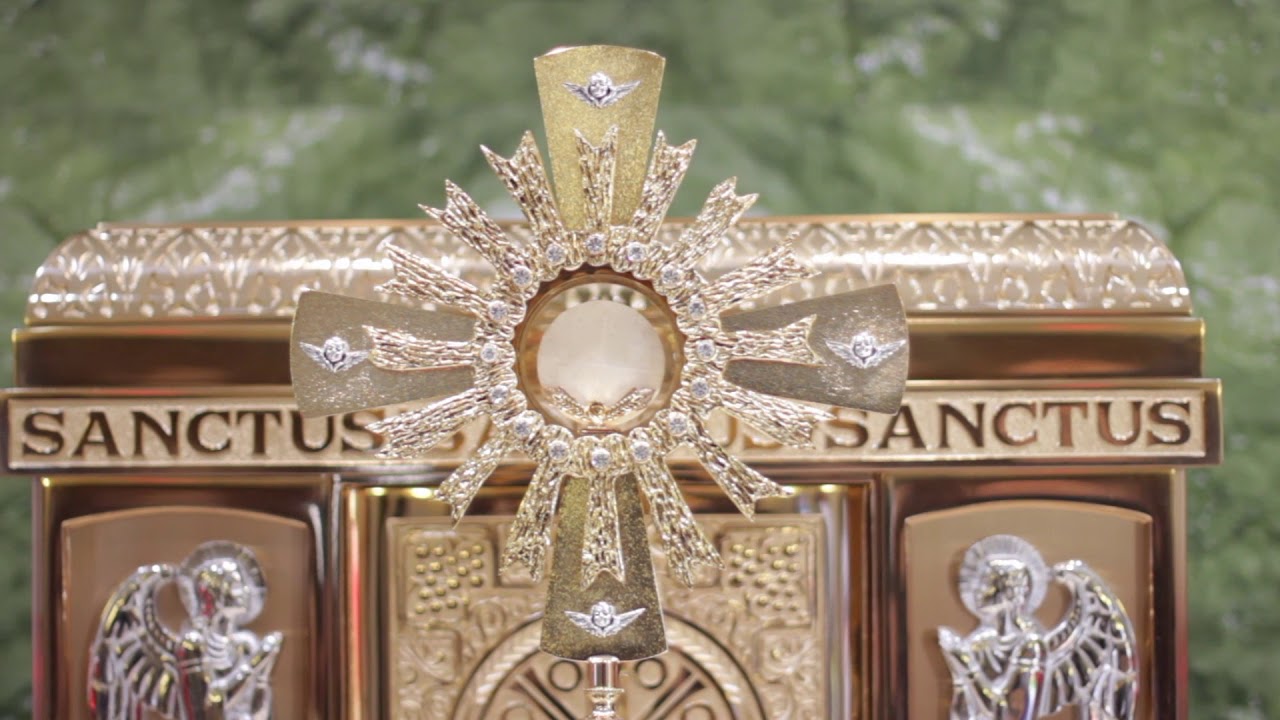
Catholic Custom: Visiting the Blessed Sacrament and Eucharistic Adoration. Jesus remains really and truly present among us in the consecrated hosts that are reserved in the tabernacle of our Catholic churches. A vigil lamp is kept burning 24/7 by the tabernacle as a sign and reminder that the Lord is present there. Because our our faith in this Abiding Presence of Jesus, it has become customary to make "visits to the Blessed Sacrament"which is the term we give to praying before the tabernacles in our churches.  When the Blessed Sacrament is taken out of the tabernacle and exposed for our worship, this prayer time is called "Eucharistic Exposition and Adoration". Some parishes, such as ours, have a special section of the church reserved for such prayer times.  These devotions to the Eucharist were not found in the early Church but came about in the Middle Ages when the Mass was no longer celebrated in the language of the people and Holy Communion was often reserved for just the priest-celebrant of the Mass. Because the baptized  experienced a kind of separation from the Blessed Sacrament, they developed these devotions to maintain some bond of union with Jesus truly present among us.  But even in our times when the Mass is in our language and Holy Communion can be a daily experience, it is still good and very helpful spiritually to practice these expressions of Eucharistic faith and devotion.


Ancient Christian Quote: "Do not, then, regard the Eucharistic elements as ordinary bread and wine: they are in fact the Body and Blood of The Lord, as He Himself has declared. Whatever your senses may tell you, be strong in faith. You have been taught and you are firmly convinced that what looks and tastes like bread and wine is not bread and wine but the Body and Blood of Christ." (St. Cyril of Jerusalem, d. 386AD, Doctor of the Church)

Saint Quote: "When you have received Him, stir up your heart to do Him homage; speak to Him about your spiritual life, gazing upon Him in your soul where He is present for your happiness; welcome Him as warmly as possible, and behave outwardly in such a way that your actions may give proof to all of His Presence." (St. Francis de Sales, d. 1622AD, Doctor of the Church)

Scripture Verses to Memorize: “I am telling you the truth: if you do not eat the flesh of the Son of Man and drink his blood, you will not have life in yourselves. Those who eat my flesh and drink my blood have eternal life, and I will raise them to life on the last day. For my flesh is the real food; my blood is the real drink. Those who eat my flesh and drink my blood live in me, and I live in them." (John 6:53-56)


Thursday, April 16, 2020

15. THE LIFE OF JESUS: FOURTH LUMINOUS MYSTERY - THE TRANSFIGURATION


APPETIZER:  Christian prayer is a covenant relationship between God and man in Christ. It is the action of God and of man, springing forth from both the Holy Spirit and ourselves, wholly directed to the Father, in union with the human will of the Son of God made man. When Jesus openly entrusts to his disciples the mystery of prayer to the Father, he reveals to them what their prayer and ours must be, once he has returned to the Father in his glorified humanity. What is new is to "ask in his name." Faith in the Son introduces the disciples into the knowledge of the Father, because Jesus is "the way, and the truth, and the life." Faith bears its fruit in love: it means keeping the word and the commandments of Jesus, it means abiding with him in the Father who, in him, so loves us that he abides with us. In this new covenant the certitude that our petitions will be heard is founded on the prayer of Jesus." (CCC #2564, 2614) 

MAIN COURSE:  The Transfiguration of Jesus (read Matthew 17:1-8; Mark 9:2-8 or Luke 9:28-36) was a profound and mystical event in which the disciples were brought into a supernatural experience of God.  The reality of who Jesus of Nazareth is - the Eternal Son of God the Father - shines forth gloriously from within him, no longer hidden for the moment by his flesh and bone humanity. The cloud that descends over the disciples is a symbol of the Holy Spirit who has come upon them. God the Father's voice is heard. Once again, he declares Jesus to be his Beloved Son and bids us to listen to him. 


Because of this mystical experience with God the Trinity, the Transfiguration has become in Christian tradition a lesson on prayer, a sign of our communion with God. In prayer, we focus of course on Jesus because he became one of us and so we can imagine him. That's who the disciples focused on as well. However, all prayer of course involves the whole Trinity, Father and Spirit as well. We go tot he Father through Jesus.  We are led by the Spirit in how to pray and in what to say.  And the fruit of our prayer is listening to Jesus speaking through his Word and in our hearts.  Thus, the Fourth Luminous Mystery invites us to enter into personal communion with God by prayer as an indispensable part of our embracing the Gospel and Kingdom of God.

I think that Christians who come from a heavily liturgical ritual church like Catholicism often find themselves a bit stumped when it comes to private prayer. And by this I do not mean praying the Rosary, the Chaplet of Mercy, the Stations of the Cross or other such devotions (which are very good and helpful forms of vocal prayer). I mean personal prayer from the heart. In one's own words. We are just not used to it nor are we trained in it as children. Both in the family and in religion classes we are taught the memorized prayers not how to converse with God as with a friend. But we can use what we do know about our human conversations to help us learn how to pray from the heart. The late Jesuit, Fr. John Hardon, once gave the following elements of human conversation as a good guide to our prayerful conversation with God.


1. We don't converse alone but with somebody else. And so to begin a conversation we must be aware of the other person and be present to them. Awareness of God, traditionally called "recollection", is the first step when praying. We place ourselves in a state of awareness of God's presence. 

2.  As in conversation with a friend, we pray in order to share ourselves, our lives, our thoughts, our needs with God.  I wish to share with God something of what is inside of me. There are sentiments in my heart, desires in my will and feelings in my soul, that I do not wish to possess alone. So I enter into the prayer of conversation in order to share.

3. We turn towards the person with whom we are conversing both physically and interiorly.  It's typically rude to speak to someone without looking at them or, if busy, at least letting them know that they have your focus, your attention. And so the same with God in prayer. We turn powders God in our body posture - we each might express this in our own way in addition to our common posture of kneeling - and we turn towards him in our minds, our hearts. This is why we Catholics have developed the use of statues, holy pictures, crosses and candles. Though not at all necessary, they help us to focus our attention while praying. Many even have a special prayer center in their home where these sacred items are displayed.


4. Finally, conversation is not a one-way street. It is a dialogue not a monologue. And so in our prayer we cannot do all the talking. We need moments of silence, solitude, stillness, to hear the interior whisper of God speaking. And he always will respond in one way or another: words impressed on our hearts; thoughts that come to our minds; a peaceful warm fullness within us; or perhaps the inspiration to look up a particular passage of Scripture.

These four elements can help us develop a more mature understanding and practice of prayer. But still sometimes it become difficult to know what to say, how to begin, when we first learn to pray from the heart as a conversation, using our own words.  I once heard something that helped me and maybe it might help you as well:  the altar is a great symbol of prayer, so take each letter of the word ALTAR rand let it guide you in forming your personal prayer:

Adore - Adoration means that we praise and glorify God who is our Father, Creator and Source of all that is. We owe him everything  that we are and every ability that we have and every good gift we possess. Bow down before him in humility.

Love - Telling someone we love them never gets old. And though God knows it he wants and like to hear it! Who doesn't like to hear the words, "I love you"?  It is not that this makes God "feel" better, but it shows that our hearts are set upon him.

Thank - St. Therese of the Child Jesus said "everything is a grace, everything is a gift from God". We acknowledge this truth by by expressing our gratitude for all the blessings, people, lesson and  yes even the difficulties in our lives (for they have something to teach us and bring out of us). Again, God doesn't need this but we do. 

Ask - Jesus said that our Father in heaven knows all that we need but he likes to hears us ask for them. Bring all of your intentions, hopes, dreams, fears, desires to the Lord in prayer. Pour out your heart before him. He wants to hear!

Repent - In our conversations and interactions with someone who has hurt us, we doubt the sincerity of heart in those who never say, "I'm sorry." In this step of repentance we speak to God in bare naked honesty, acknowledging our sins and asking for forgiveness. We depend upon him to be our strength in weakness and our power in powerlessness in the struggle to do good and avoid evil.


DOGGIE-BAG: Here are a few things for you to take away for your spiritual snacking throughout the day:

The saint quotes below are from the most contemporary "Doctor of the Church".  This is a special title of honor given to a saint whose writings have greatly influenced the Christian people as helpful in living out the Gospel of Christ. "Doctor" here is used in its educational sense...so we might say that these saints are PhD's in Gospel-living!  St. Therese's autobiography "The Story of a Soul" has long been the second best seller among Catholics after the Holy Bible. And through it her "Little Way of Love" has influenced thousands.  Only 36 saints have been declared Doctors of the Church. If you are the curious type and want to know who they are go to this link: https://www.ncregister.com/blog/astagnaro/36-doctors-for-all-that-ails-you

Saint Quote:  "For me, prayer is a surge of the heart; it is a simple look turned toward heaven, it is a cry of recognition and of love, embracing both trial and joy." 

"I pray as a child would who cannot read - I just say what I want to say to God, quite simply, and he never fails to understand."

For me, prayer means launching out of the heart towards God; it means lifting up one's eyes, quite simply, to heaven, a cry of grateful love, from the crest of joy or the trough of despair; it's a vast, supernatural force which opens out my heart, and binds me close to Jesus.

(St. Therese of the Child Jesus, d. 1897AD,  Doctor of the Church)


MEDITATION /MENTAL PRAYER: When the disciples said to Jesus, "Lord, teach us to pray",  he responded by giving them the "Our Father". It is both a prayer in itself and a lesson in prayer by showing us the various elements that should make up our personal conversation with God. It is a good idea at times to take such a prayer that we know so well (this can be done with the Hail Mary as well) and say it slowly, pausing after each phrase to consider what it means. This is a form of prayer called "mental prayer" or"meditation"in which we ponder what we say and draw lessons from our meditation to apply to our every day lives.

SCRIPTURE VERSE TO MEMORIZE: "Lord, teach us to pray..." (Luke 11:1)

Wednesday, April 1, 2020

14. THE LIFE OF JESUS: THIRD LUMINOUS MYSTERY - THE PREACHING OF THE GOSPEL


APPETIZER:  After John the Baptist was arrested, Jesus came into Galilee, preaching the gospel of God, and saying: 'The time is fulfilled, and the kingdom of God is at hand: repent, and believe in the gospel.'" Everyone is called to enter the kingdom. To enter it, one must first accept Jesus' word. The kingdom belongs to those who have accepted it with humble hearts. Jesus invites sinners to the table of the kingdom as He said: "I came not to call the righteous, but sinners." He invites them to that conversion without which one cannot enter the kingdom, but shows them in word and deed his Father's boundless mercy for them and the vast joy in heaven over one sinner who repents. The supreme proof of his love will be the sacrifice of his own life for the forgiveness of sins. Jesus' invitation to enter his kingdom comes in the form of parables, a characteristic feature of his teaching.  Jesus accompanies his words with miracles,"mighty works and wonders and signs", which manifest that the kingdom is present in him and attest that he was the promised Messiah. The coming of God's kingdom means the defeat of Satan. (CCC 541-550)

MAIN COURSE: WOW! There is enough in today's appetizer alone to carry us through a whole year of this catechism party! But we'll have to stick to just the highlights and the basics, leaving those who wish to know more to read some of the many books that have been written on the public ministry of Jesus, the meaning of the Kingdom of God, etc. To put it in a nutshell, this Third Luminous Mystery covers the entire Public Ministry of Jesus, which is what we call the period of about three years following his Baptism in the Jordan during which he went about preaching, teaching, healing, exorcising, etc. During this time he was also making enemies among the Jewish leadership who were envious of his popularity and leary about the soundness of his theology.

The official full title of this Third Luminous Mystery is "The Proclamation of the Kingdom and the Call to Conversion".  That's a mouthful and one can easily see why shorter titles for it have quickly arisen (such as mine above).  But the beautiful thing about it is that it encompasses so much for us to think about and absorb. Let's start doing that by reviewing the basic terms in the original title. This will inform us as to what the Public Life & Ministry of Jesus was all about.  

Proclamation.  The evangelists (gospel-writers) tell us that after his Baptism and 40 days in the desert,  Jesus  returned to Galilee and begins proclaiming, announcing, preaching the Gospel. We are told that this was the simple basic content of his proclamation: “The kingdom of God is at hand. Repent, and believe in the gospel.” (Mark 1:15, translation used in our liturgy)  Or as a much more modern translation of the Bible puts it: “Time’s up! God’s kingdom is here. Change your life and believe the Message.” (Mark 1:15, The Message Bible translation).  This proclamation remained the heart and soul of everything Jesus said, taught and did right up to his crucifixion and then again after his Resurrection. 

Gospel.  The proclamation of Jesus, encouraging people to change their lives and embrace a new and transformed relationship with God and one another, is called the Gospel. Or in its original Greek vocabulary, the Evangelion which means Good News. In modern translations today it is also being called the Message. And so we say that Christians accept, strive to live and spread the Gospel of Jesus, the Good News of Jesus or the Message of Jesus.  It is the core message of Christianity because its call to repentance and faith are is the doorway through which human beings enter into a an everlasting relationship with God.

Kingdom.  While repentance and faith were the main themes of Jesus' proclamation of his Gospel,  it's focus or goal was the Kingdom of God, aka the Kingdom of Heaven. This does not refer primarily or exclusively to "Heaven" as in our ultimate destination after life on planet Earth.  In other words, this title is referring more to a state of being or a way of living than to a place or destination.  Kingdom in Jesus' ministry means the "authority, lordship, rule, reign" of God in a person's life. The Kingdom of God was the #1 topic of Jesus' parables and teachings.  His many miracles were signs that this Kingdom was bursting into human history and changing lives. 

Call to Conversion.  It is easy, I think, to now see why the second part of Third Luminous Mystery's title is "Call to Conversion". (invitation, summons).  It's obvious to us now that this goes hand in hand with the first part of the title, "Proclamation of the Gospel".  A call is a summons or invitation and Jesus extends this to all human beings without exception. He did it personally when he lived on planet Earth and he has continued to do it throughout history - and even now - through the disciples  (including you and me) who form his Body the Church. Conversion is the translation of the original Greek word metanoia which means complete reversal, a change, a u-turn in the way we have been thinking and living IF this way has been based on the selfish, materialistic, "worldly" outlook.

Putting it all Together.  So when Jesus says,“The kingdom of God is at hand. Repent, and believe in the gospel.” what he means is the invitation and opportunity to have a new and eternal life with God is being offered to you here and now. And the way for this to happen if for you to have a real change of mind and heart that is shown in a new way of living. Put your trust in me and live out my Message.

DOGGIE BAG: Here are a few things for you to take away for your spiritual snacking throughout the day:

Quote from Pope Francis:  “Let us not forget: if we are to proclaim the Gospel of Jesus, our lives must bear witness to what we preach.” (Twitter, 4/14/2013)

Prayer for Radiating Christ:  Dear Jesus, help me to spread Your fragrance everywhere I go. Flood my soul with Your spirit and life. Penetrate and possess my whole being so utterly that all my life may only be a radiance of Yours. Shine through me and be so in me that every soul I come in contact with may feel Your presence in my soul. Let them look up and see no longer me but only Jesus! Stay with me and then I shall begin to shine as You shine, so to shine as to be a light to others; the light, O Jesus, will be all from You; none of it will be mine: it will be You shining on others through me. Let me thus praise You in the way You love best: by shining on those around me. Let me preach You without preaching, not by words, but by my example, by the catching force, the sympathetic influence of what I do, the evident fullness of the love my heart bears to You. Amen. (By St. John Henry Newman d. 1890, a favorite prayer of St. Mother Teresa of Calcutta, prayed daily by her Missionaries of Charity)

Short Prayers to Repeat Silently Throughout the Day: (Choose one or combine all three)
Jesus, I believe in your love for me. 
Jesus, I trust in you. 
Jesus, shine through me to others.

SCRIPTURE VERSE TO MEMORIZE:  "Seek the Kingdom of God above all else, and live righteously, and he will give you everything you need." (Matthew 6:33, New Living Translation)

49. BITESIZE CATECHISM: THE SEASON OF LENT - ASH WEDNESDAY

  APPETIZER:  Jesus’ temptation in the wilderness reveals the way in which the Son of God is Messiah, contrary to the way Satan proposes to ...